
8 things you may not know about 1066
Everyone knows about 1066 and all that, right? Even if you know your Harold Godwinson from your Harald Hardrada, here are eight facts about that fateful year that might surprise you.
1. The appearance of Halley’s Comet was seen as an important omen
The appearance of comets in the sky was generally a cause of concern for medieval people, primarily because they were believed to herald change – the death of kings or princes, or the end of kingdoms.
Although the Bayeux Tapestry shows the appearance of Halley’s Comet in the sky at the same time as Harold is crowned king of England just after the death of Edward the Confessor, the comet actually appeared around three months after Harold’s coronation.
With William of Normandy preparing an army to invade England at this time, the appearance of the comet may therefore have been seen as an omen of a coming war for the throne.
2. There were two other important battles in 1066
Harold Godwineson and William of Normandy were not the only contenders for the English throne in 1066.
Harold’s banished brother Tostig invaded England with King Harald Hardrada of Norway and his Norse army. Tostig and Hardrada defeated the northern and midland English earls on 20 September at Fulford near York, before themselves being defeated on the 25 September at Stamford Bridge, East Yorkshire, by an army led by Harold himself.
These battles don’t feature on the Bayeux Tapestry, partly because they don’t directly involve William (whose half-brother probably commissioned the tapestry) but also because it wasn’t created as a definitive historical account.
3. It wasn’t obvious William would win the battle
The English and Norman armies were fairly evenly matched, which is why the battle lasted most of the day – unusually long for a medieval battle.
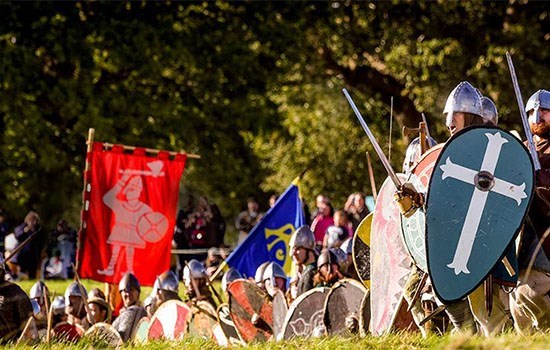
The English formed very long ‘shield walls’, where fighters would stand shoulder to shoulder with their shields touching or overlapping. This positioning created great difficulties for the attacking Normans, who couldn’t break the wall.
In order to get the shield wall to break, the Normans pretended to retreat, encouraging the English to chase them. When several English fighters obliged, the Normans were able to attack with greater success and went on to win the battle.
4. A minstrel struck the first blow in the Battle Of Hastings
Ivo Taillefer, William’s minstrel (a singer, musician, or performer) killed the first English combatant of the battle.
The Carmen de Hastigae Proelio ('Song of the Battle of Hastings'), probably written in 1067, dramatises the story by telling how an English warrior ran at Ivo, who was on horseback and taunting the English army by juggling with his sword. Ivo supposedly pierced his opponent's shield with his lance before decapitating him with his sword. Ivo then showed the head to his comrades, who cheered at him landing the first blow.
5. Harold may not have been killed by an arrow in his eye
Harold’s death is described in different ways by different sources, presenting contradictions and no clear narrative. The Bayeux Tapestry as it’s seen now and sources from the century after the Battle of Hastings suggest Harold was killed by an arrow to his head – though on the Tapestry, the arrow was added in the 19th century during heavy-handed repairs.
The written accounts nearest to the date of the battle itself, however, suggest the English king was hacked to death and dismembered by four Norman knights, one of whom may have been Duke William himself.
The narrative of Harold being killed by a stray arrow rather than directly (and bloodily) by William himself may have been perpetuated by William as evidence of God granting victory to the Normans.
6. The location of Harold’s body remains unknown
Early sources record that William denied Harold’s mother her son's body, even though she offered its weight in gold. This is contradicted by later sources, which say that Harold’s mutilated body was identified by his mistress and buried at Waltham Abbey, Essex, which he had re-founded.
Parts of the abbey remains are in English Heritage care, and you can still see his alleged grave there. But the exact location of Harold’s body is disputed to this day.
7. You can visit the spot where Harold was killed
Battle Abbey was was founded by William soon after the Norman Conquest in penance for the blood that had been spilled at the Battle of Hastings.
Visitors who come to the abbey today can see a stone marker showing where Harold fell during the battle. William insisted that the high altar of the abbey church should mark the place where Harold fell.
Appearing to honour Harold in this way would have been designed to help William to win over those in England who opposed him.
8. Modern English is a result of the Norman Conquest
The English we speak today is the product of a lot of intermingling with French words. 'Poor', 'letter', 'age', and 'pork' are all words with Norman-French origins, to name just a few.
One of the most obvious changes to English culture after 1066 occured in the names people called themselves. French names like William, Robert and Henry became popular among the general population – and for the first time, inherited surnames started to appear, replacing nicknames (such as Edmund 'Ironside') or names indicating paternity (such as 'Edmund, Cuthbert's son').
Discover more
-
1066 and the Norman Conquest
Discover more about the Battle of Hastings and its consequences.
-

Visit the 1066 battlefield
Explore the site of the most famous battle in English history.
-

What happened at the Battle of Hastings?
At dawn on Saturday 14 October 1066, two great armies prepared to fight for the throne of England.