GENTRY, Amy (1903–1976)
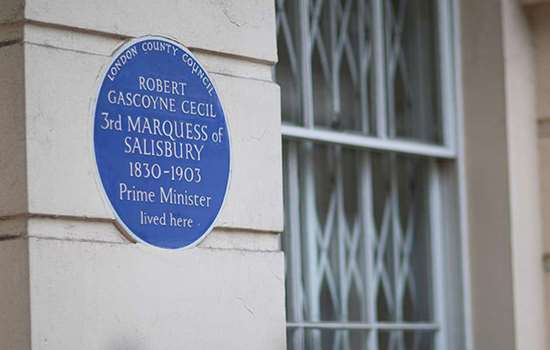
Plaque erected in 2026 by English Heritage at 29 Thornton Road, East Sheen, SW14 8NS, London Borough of Richmond Upon Thames
All images © English Heritage
Profession
Pioneer of women’s rowing
Category
Sport
Inscription
AMY GENTRY 1903–1976 Pioneer of women’s rowing lived here
Material
Ceramic
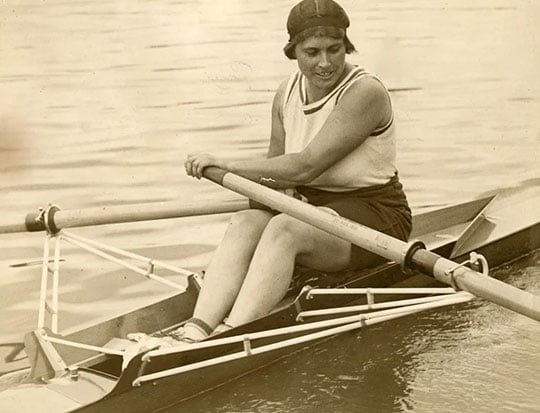
Amy Gentry was known for her extraordinary contributions to the sport of rowing. She is commemorated by a blue plaque at 29 Thornton Road, East Sheen, where she lived during the peak of her success as an oarswoman, and continued her advocacy for women’s rowing.
Amy Gentry was born in Barnes on 26 July 1903. Her parents, Carl and Amy, were cockneys and had Amy baptised in the City of London. The family lived in a terraced house on White Hart Lane for many years.
Gentry dated her lifelong love of the river from when she was just one month old. Her parents, she said, took her for an outing on the Thames and ‘christened’ her over the side of the boat somewhere between Richmond and Twickenham.
The Gentry family always had holidays beside the river, mostly on a camping plot on what became known as Hamhaugh Island at Shepperton. Here, the family spent their holidays and, if they could afford it, their weekends.
Racing on the river
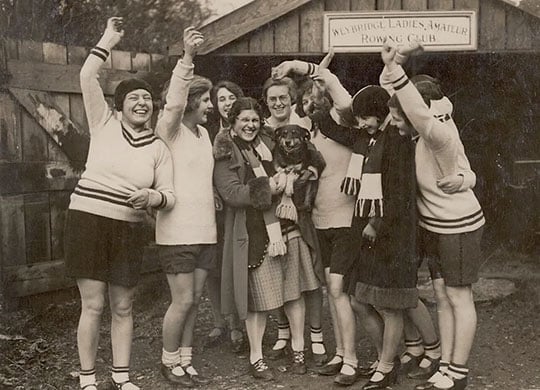
Gentry began competing in dinghy races aged about six or seven. The Weybridge Rowing Club introduced a ladies’ fours race in 1919 and coached 16 girls, including Gentry, for the event. It was a huge success and a ladies’ section was added to the club in 1920. In 1926 it became the Weybridge Ladies Amateur Rowing Club, with its own boathouse. Gentry, its captain from the outset and later its chair, was indefatigable in her support for the club throughout her life.
Gentry rowed successfully in club competitions in the 1920s and 1930s. She and her brother won the mixed double skiff championship three years running between 1924 and 1926. Weybridge Ladies competed successfully in regattas at Brussels in 1925 and Ostend in 1930. Gentry became British single sculls champion in 1932, 1933 and 1934, retiring undefeated.
Thornton Road
By the time of Gentry’s single sculls triple triumph – probably in 1929 or 1930 – she had moved with her parents to the address that bears her plaque, 29 Thornton Road in East Sheen. This substantial double-fronted corner house, which dates from the early 20th century, remained her home until 1939, when the family moved to Shepperton, where they had built a bungalow on Hamhaugh Island, and where Gentry lived for the rest of her life.
The Women’s Amateur Rowing Association
The 1920s saw enthusiastic growth in ladies’ clubs and regattas began to include ladies’ races. However, the Victorian idea that women should only enjoy boats for leisure and that racing should be a masculine preserve persisted in some circles. The British Amateur Rowing Association (ARA) would not acknowledge women’s rowing competitions and penalised clubs that permitted female membership by refusing them affiliation.
In response, the Women’s Amateur Rowing Association (WARA) was established in 1923. Its name, using ‘women’ rather than ‘ladies’, signified a shift to competitive rowing. The WARA aimed to hold women to the highest standards of oarsmanship, to organise regattas for women, and promote boat racing among women. Gentry soon became a key member – she was on its committee from 1928, and became chair from 1939. Due to Gentry’s strenuous efforts, the WARA sent British teams to international women’s meetings: Warsaw in 1931, Paris in 1933, and Australia in 1938.
Throughout her life, Gentry juggled rowing, being active in the WARA, and serving as club captain of Weybridge Ladies, while also earning her living as a secretary in busy offices. She was unable to join the trip to Australia because at the time of the race, she had a role at Vickers, working with the inventor of the ‘bouncing bomb’, Barnes Wallis, and could not be spared.
Post-war
After the Second World War, several European national rowing federations included women’s rowing in their championships. In 1960 Amy Gentry achieved an enormous success for British women’s rowing. She persuaded the Fédération Internationale Sociétés d’Aviron, which regulated international amateur rowing, to stage the seventh Women’s European Championships on the Welsh Harp reservoir in north-west London, supported and financed by the Borough of Willesden. The WARA and ARA drew together to organise this prestigious event and from this collaboration the Women’s Amateur Rowing Council (WARC) developed as part of the ARA. Gentry was its chair until her retirement in 1968.
In 1969, shortly after her retirement from the WARC, Amy Gentry was appointed to the Order of the British Empire for services to women’s rowing. She continued to give moral, practical and financial support to Weybridge Ladies up until her death, on 11 June 1976. Gentry had been campaigning for women’s rowing to be part of the Olympics from 1927 and she died just weeks before a Weybridge Ladies coxed four raced at the 1976 Montreal Olympics – the first Olympics in which female rowers were allowed to compete.
Further Reading
- Neil Wigglesworth, ‘Gentry, Amy Constance (1903–1976)’, Oxford Dictionary of National Biography (2007) (access with a UK public library card)
- Eloise Chapman, ‘The Indomitable Amy Gentry: Pioneer of Women’s Competitive Rowing’, Hear the Boat Sing (March 2016)
Nearby Blue Plaques
See these places on an interactive Google map.