History of Arthur’s Stone
Arthur’s Stone, a Neolithic chambered tomb, is over 5,000 years old. Today only the large stones of the inner chamber remain, though these were once covered by a long earthen mound. Recent archaeological discoveries are transforming our understanding of the site.
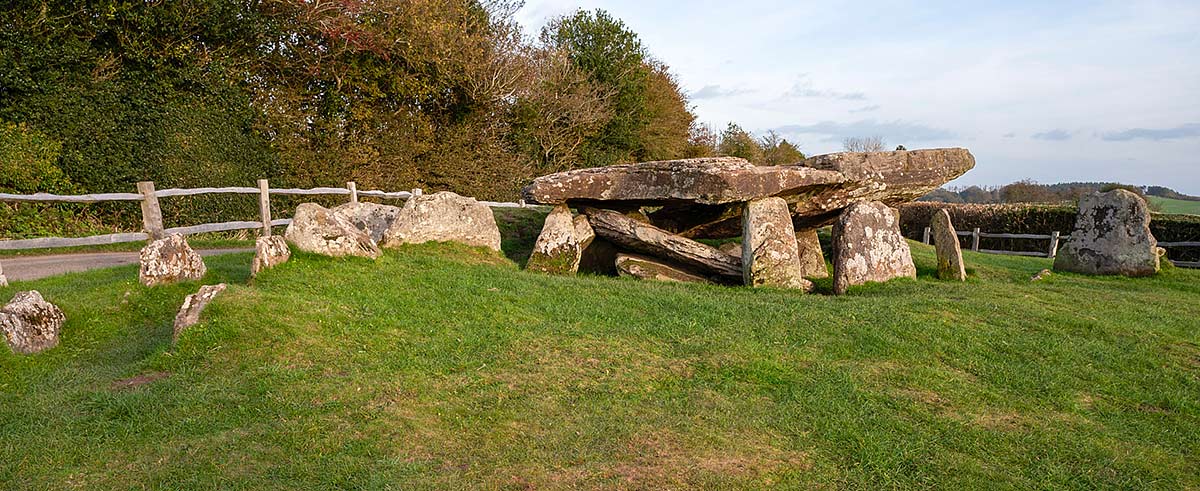
The chamber is formed of nine upright stones, with an enormous capstone, estimated to weigh more than 25 tonnes. It was accessed through the side of the covering mound, via the right-angled passage. There is an isolated stone that probably formed part of a false entrance, perhaps providing a visual focus for ceremonies.
It is unlikely that the monument was built solely as a tomb. Rituals to honour the ancestors buried in the tomb may have taken place here. This suggests that a strong connection to this place was established over hundreds of years by early farming groups who used and altered the tomb. As the tomb was built in an area of summer pastures, Neolithic people could have gathered at the cairn on a seasonal basis.
Like many prehistoric monuments in western England and Wales, this tomb has been linked to King Arthur since before the 13th century. According to legend, it was here that Arthur slew a giant who left the impression of his elbows on one of the stones as he fell.
Excavations
Since 2023, the site has been undergoing targeted excavations led by the University of Manchester, University of Cardiff and Herefordshire Council’s Archaeology Section, in collaboration with English Heritage and Historic England. This is giving us new insights into the construction and use of the monument.
The excavations have shown that the tomb originated as a ‘dolmen’, comprising a giant capstone sitting on top of upright stones, surrounded by a circular bank of stones. This was later enlarged into a long trapezoid-shaped tomb, bounded by dry-stone walling. Tombs of this type are known as Cotswold–Severn-style long barrows, or cairns – a type of early Neolithic tomb that is found in the Cotswolds, Wessex and south Wales.
Excavations around the entrance, and within the passageway and chamber, recovered Neolithic pottery and stone tools, including a piece of worked rock crystal, most likely from north Wales, and a piece of pitchstone from the Isle of Arran in Scotland. The excavations also recovered deposits of human bone from multiple individuals.
A stone quarry and other monuments have been found in the landscape surrounding the site.
Further reading
Children, G and Nash, G, A Guide to Prehistoric Sites in Herefordshire (Woonton Almeley, 1994)
Gibson, A and Simpson D (eds), Prehistoric Ritual and Religion: Essays in Honour of Aubrey Burl (Stroud, 1998)
FIND OUT MORE
-
Prehistoric Monuments
England’s prehistoric monuments span almost four millennia. Discover what they were used for, how and when they were built, and where to find them.
-

History of Nympsfield long barrow
Read a brief history of a typical Cotswold–Severn long barrow and watch a video explaining the meaning and purpose of these monuments.
-
MORE HISTORIES
Delve into our history pages to discover more about our sites, how they have changed over time, and who made them what they are today.