
History of Landguard Fort
For over 500 years a fort on Landguard Point defended the entrance to the important east coast port of Harwich. Henry VIII commissioned the first fortifications on the point around 1543, and a larger fort was built in the 1620s. In 1667 its garrison repulsed a Dutch attack which was intent on destroying the fort and the naval facilities of Harwich.
The current pentagonal fort was built in the mid 18th century and updated in the 1870s with a huge casemated battery for massive, rifled guns. Landguard remained in military use, notably during the two world wars of the 20th century, until it closed in 1957.
Tudor defences
The first plan to protect Harwich Haven with artillery defences emerged under Henry VIII. The fear of invasion from the combined forces of France and Spain triggered a programme of fort building along England’s south and east coasts, intended to prevent the enemy from landing and capturing major harbours. In 1539, the medieval walls of Harwich were strengthened, with women and children helping to dig trenches and raise ramparts.
In 1542, after a visit by the king, five small earthwork and timber artillery forts (bulwarks) were built. Two of these were at Landguard, including one about 350 metres east of the present fort, later lost to the sea.
Rising tensions in the 1580s – particularly the prospect of a Spanish invasion (the Great Armada) – led to improvements. These included a stone bulwark to defend Harwich and repairs to the Landguard bulwarks, where 46 cannon were mounted.
The second fort, 1625–8
After James I’s accession in 1603, negotiations ended the war with Spain (1585–1603). English defences were neglected over the following 20 years. When war resumed with Spain in 1625, a few strategic locations were strengthened. They included Harwich, where a Half-moon Battery was built on the quayside, and Landguard, where a new fort was completed by 1628.
The new fort was influenced by Dutch designs. It had a low profile and was square in plan, with acute-angled bastions for artillery at each corner, a broad external ditch crossed by a drawbridge, and a brick defensive wall for infantry near the base of the inner slope of the ditch. Inside, around a small parade ground, were brick barracks, a governor’s lodging, magazines, an aqueduct and water conduit house, and a chapel.
The garrison held for Parliament throughout the First and Second Civil Wars of 1642–6 and 1648, though by 1647 the defences were badly eroded by wind, sea and rain.
Despite this neglect, throughout the three Anglo-Dutch Wars (1652–4, 1665–7 and 1672–4) Landguard Fort remained as the main defence for Harwich Haven, by then a naval dockyard and important anchorage.
The Dutch assault of 1667
In 1666, during the Second Anglo-Dutch War, Landguard Fort was reinforced with a detachment of the Duke of York and Albany’s Maritime Regiment of Foot (a forerunner of the Royal Marines).
The next year saw Landguard’s most famous moment. It followed a humiliating defeat on the river Medway in June 1667, when the Dutch attacked the English fleet at Chatham. They burned several English warships and towed off two others as prizes.
On 2 July, the Dutch approached Harwich. Twelve warships from their 70-strong fleet attempted to bombard Landguard Fort, to clear a passage into the haven. But choppy waters prevented them from firing accurately.
At the same time, a force of 800 Dutch soldiers landed and twice tried to storm the fort. But Captain Nathaniel Darell and his 200-strong defenders repelled them with musket fire. The Dutch retreated, leaving eight dead, while only one Englishman was killed.
The 18th century: a new fort
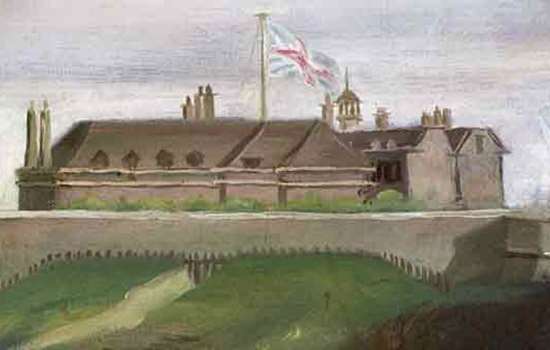
During the War of the Spanish Succession (1702–13), when England fought against France, measures were taken to secure naval dockyards, including Harwich. With the fort at Landguard beyond repair, ambitious plans for a new one were made. These were scaled down and in 1717–20 a smaller fort emerged, combining a battery of 20 guns and a barracks for 30 men.
The new fort was small because it was intended to work with new and larger fortifications in Harwich. But when, after a decade, nothing had emerged there, Landguard Fort was enlarged. Between 1730 and 1733 another storey was added to the barracks and a larger battery of heavier guns made.
A few years afterwards, against a background of another conflict with France (the War of Austrian Succession of 1742–8) and the Jacobite rebellion (1745–6), the Board of Ordnance constructed a new fort at Landguard. Built between 1744 and 1750, this retained the two main faces, barrack block and parade of the existing fort in a larger pentagonal design, with projecting bastions at each angle.
Casemates (bombproof, vaulted chambers, used for storage, workshops, accommodation etc) were built under the ramparts and other buildings were erected inside. Beyond the ditch was another earth and timber rampart for musketry defence. By 1753 a new heavy artillery battery – Beauclerk’s Battery – had been added on the haven side.
Life at Landguard in the 17th and 18th centuries
Landguard was an isolated posting on a lonely peninsula. Over the years, it had a varied garrison.
In the 17th century, its soldiers were often short of supplies and pay from an impecunious government. In 1661 Colonel Henry Farre’s 112 men complained of their diet of bread and cheese, and that with only 20 bedsteads most men had to sleep on the floor.
The garrison size fluctuated, rising for example from 77 in 1627 to 126 in 1628. A minor mutiny in 1628 was quickly stopped and Captain Gosnold allowed the offenders to draw lots so that only one man was punished. The unlucky Benjamin Dammont was despatched to gaol near Woodbridge, Suffolk, but was released on route by a village constable who took pity on him.
For much of the 18th century, an Invalid Company of soldiers – men who were unfit for service abroad – manned Landguard. A master gunner and a few assistants maintained the guns. It was normal for peacetime garrisons to be under strength, topped up with militia (part-timers) or regular troops in wartime.
The fort commanders, or governors, were often absentees, appointing lieutenant-governors in their stead. Some brought their families to live with them, including Sir Roger Manley (governor 1680–87), whose daughter Delarivier spent her teenage years at Landguard. As an adult, she became popular as a playwright, novelist and author of salacious political works.
The most notorious lieutenant-governor, Philip Thicknesse, bought his post in 1753. Known for quarrelling with local officials, he was imprisoned for three months for slander after one dispute. Eventually, judged unfit for command, he resigned in 1766 and travelled in Europe with his family, writing lucrative travel books and popular memoirs.
The American and Napoleonic wars
During the American War of Independence (1775–83), there were fears of invasion by France, Spain and the Netherlands, who allied with the Americans. New earthwork defences were begun across the peninsula north-east of the fort, to protect against land attacks and to create a defended camp for a mobile force. Construction began in 1782 but was incomplete when the war ended.
Britain was soon engaged in another bitter conflict with France. During the French Revolutionary and Napoleonic wars (1793–1815) there were three invasion scares, in 1798, 1803 and 1804. This prompted a defence review, and between 1805 and 1812 a series of gun towers (called Martello towers) were built along the English south and east coasts. At Harwich a new fort, the Circular Redoubt, was built between 1807 and 1810. Its ten powerful guns, each firing shot weighing 24 pounds, covered the town against landward assault and the haven against ships that might slip past Landguard.
Landguard Fort was also upgraded, notably in 1806, when the 42-pounder guns of Beauclerk’s Battery were placed on traversing carriages to enable them to fire over wider arcs. By 1817, the 24-pounder guns on the bastions had similar carriages.
No invasion materialised, and when peace came in 1815 defences were reduced nationwide. But Landguard Fort and the Circular Redoubt retained their guns and garrisons.
Victorian rebuilding
By the mid 19th century, technological developments were transforming warfare. Fast steam ships, with hulls protected by iron plate and carrying new, powerful rifled guns, posed an existential threat to coastal forts. Nationwide defences needed radical change, and after 1860 the greatest period of fortress building ever witnessed in the British Isles began.
Initially, some haven defences were upgraded, but Landguard Fort was not. However, between 1870 and 1878 its west and south-western ramparts and one bastion were demolished and replaced with a curved casemated battery, massively constructed of granite and iron. It held seven huge rifled muzzle-loading (RML) guns. Behind it, replacing previous buildings, a curved defensible barrack mirrored the shape of the new battery. The remaining ramparts and four bastions of the old fort were remodelled for a further nine RMLs.
In 1877–80, a Submarine Mining Establishment (SME) was built within the fort’s northern outworks. This comprised a low brick building (the Ravelin Block) and several ancillary structures. It formed the workplace of a specialist group of Royal Engineers, who laid and monitored an explosive minefield across Harwich Haven.
Mines were transported on a tramway to a jetty, for a specially adapted boat to deploy them. One type of mine floated just under the water’s surface, secured to the seabed by long cables, and was designed to explode if a ship bumped against it. Another type rested on the seabed and could be detonated by an observer in the fort via a cable when an enemy ship was directly above it.
Even as the RMLs were being installed, the Army realised that they were too heavy and slow to counter faster warships with even more powerful guns. A solution came with new breech-loading (BL) guns. These fired shells further and more accurately, from mountings that enabled rapid loading and firing, and better control of recoil. In 1889–90, two experimental ‘disappearing guns’ were installed in a new battery, Left Battery, outside the fort. On firing, they retracted into a deep gun pit that allowed for reloading hidden from enemy fire.
Two more batteries were built outside the fort a decade later (1898–1902). They were equipped with breech-loading guns on a new type of mounting in which the barrel recoiled along its axis, making them even quicker to load and fire. Right Battery’s guns faced the sea to counter larger warships, while Minefield Battery looked across the haven to defend against fast torpedo boats that could avoid the minefield. It was renamed Darell’s Battery after the hero of 1667.
The world wars
When the First World War began in 1914, Harwich became a War Anchorage for the Royal Navy. To protect it, Landguard and Harwich were fortified with trenches, barbed-wire entanglements, pillboxes and earthwork redoubts. Seaborne passage to and from the haven was strictly controlled from a Port War Signal Station, built into the Fire Commander’s Post on the roof of Landguard Fort. The submarine minefield remained in place.
The end of the war witnessed a remarkable sight when 122 German U-boats arrived in the haven to surrender.
In 1939 Harwich again became an important naval base, for safeguarding merchant shipping along the east coast. In May 1940, its ships played a significant part in the evacuation of Allied forces from Dunkirk.
Later in the war, preparations were made in Felixstowe Dock and at Landguard for the D-Day landings. On 6 June 1944, troops and tanks departed on landing craft and ships from three concrete embarkation ‘hards’ that had been built into the water for the huge deployment.
Throughout the war, Landguard Fort was the Fire Command Headquarters for the haven defences. The fort armament was upgraded with two twin 6-pounder guns in a reconstructed Darell’s Battery, with their own control towers and searchlights.
In 1942 Landguard Right Battery was partly modified for two 6-inch guns that had longer ranges and the ability to fire at 45° elevation. This meant they could land shells on the vulnerable decks of enemy warships. The installation of radar in 1944 enabled the guns to fire even more effectively.
Another important contribution was anti-aircraft defence. Harwich was a target for enemy bombing raids, especially in 1940–41. Heavy anti-aircraft batteries in the surrounding area were coordinated initially from Landguard Fort, while an extensive balloon barrage helped to hinder bombing runs of enemy aircraft. Some 25 aircraft were shot down in the Harwich area by air and ground defences during the war.
Decline and decommissioning
At the end of the war, only key defences were maintained. Part of Left Battery was converted to coordinate the operation of six anti-aircraft batteries, until this function moved to Mistley in 1953.
Similarly, the haven’s coast defences were coordinated from a Seaward Defence Headquarters established in 1951 in the fort’s casemated battery. The guns at Darell’s Battery were modified to enable anti-aircraft fire as well as seawards fire.
In 1956, however, all coast and anti-aircraft artillery was decommissioned nationwide, as guided rocketry had rendered it obsolete. Nevertheless, the Army kept a presence at Landguard into the 1960s.
Today, although its 420 years of active service have ended, the fort is an impressive monument to the long story of coastal defence in the British Isles. It is managed as a visitor attraction by the Landguard Fort Trust, whose volunteers are supported by English Heritage.
By Paul Pattison
Find out more
-

Visit Landguard Fort
Explore Landguard Fort’s long military and maritime heritage and enjoy the splendid views of the Port of Felixstowe and the haven from Harwich Bastion.
-
Philip Thicknesse, Landguard’s Loosest Cannon
Read more about Philip Thicknesse, and how he finally got his comeuppance after a life of self-inflicted scandal in 18th-century England.
-

Download a plan
Download this pdf plan of Landguard Fort to see how its buildings, and the defences of the haven, developed over time.
-

Buy the guidebook
The guidebook includes a guided tour of the fort buildings, as well as a complete account of Landguard’s colourful history.