
History of Sibsey Trader Windmill
Rising above the flat fenland landscape, this massive windmill was built in 1877. It processed locally grown wheat, barley and oats into flour and animal feed, and remained in commercial use until the 1950s. One of the last Lincolnshire windmills to be built, it is a superb example of Victorian engineering and traditional technology, and one of very few six-sailed windmills still surviving.
Recent conservation work has brought the mill back into full working order, complete with its six sails and a new rotating cap.
The mill’s origins
For thousands of years people have harnessed the power of wind, water and animals to grind cereals such as wheat and – since the Middle Ages – to power machinery such as saws to cut timber. A mill is both the power station that generates power and the factory that uses it.
Lincolnshire had about 500 working mills in the early 20th century. These included windmills and watermills for grinding cereals into flour and animal feed, and smock mills for pumping fen water into channels.
Early windmills were built of timber, but by the 19th century an increasing number of windmills in East Anglia were built of brick. Although more costly to build, brick windmills required less maintenance than timber mills.
The internal structures of all these mills used timber and iron.
In 1877 William Clapham, the miller of an old timber mill at Sibsey, invested in a new brick windmill. Unlike older post mills, in which the whole timber superstructure turned, this was a tower mill: the timber-framed cap and sails turned to face the wind, supported on a sturdy brick tower.
Built by the Lincolnshire millwrights Saundersons of Louth, it was taller – standing 23 metres high – and broader than the old mill. This made for less cramped working conditions for the miller and provided space for up to four pairs of millstones to turn at once.
The six sails harnessed a great deal of wind power. If one or two sails were damaged in a storm, the mill could still operate with four sails. William Clapham, assisted by his nephew-apprentice, had a fine, powerful modern mill.
From field to fork
By the early 19th century the great landscape transformation of Lincolnshire was complete. The low-lying fens had been drained (by pumping water into raised channels) and the land was now predominantly used for growing cereal crops rather than grazing cattle.
Mills such as Sibsey Trader Mill were at the heart of a local economy in which cereals such as wheat were grown, harvested, milled, baked and eaten. In the 1930s and 1940s the miller, Tommy Ward, bought wheat from local farmers such as Robert Clarke. Ward milled this into a fine flour and sold it to bakers such as Sarah Capps in the village of Sibsey.
Barley was also used in baking bread, but malted (sprouting) barley was coarsely milled for brewers like Batemans of Wainfleet.
However, the market for milled grain was changing. Wheat was increasingly milled into flour in large town mills, so traditional millers like Tommy Ward concentrated on supplying animal feed to local farmers. Ward bought oats from one farmer, milled them coarsely and sold them to other local farmers such as his neighbour John Neal in Frithville, who used it as a food supplement for cattle and horses.
Harnessing wind and water power
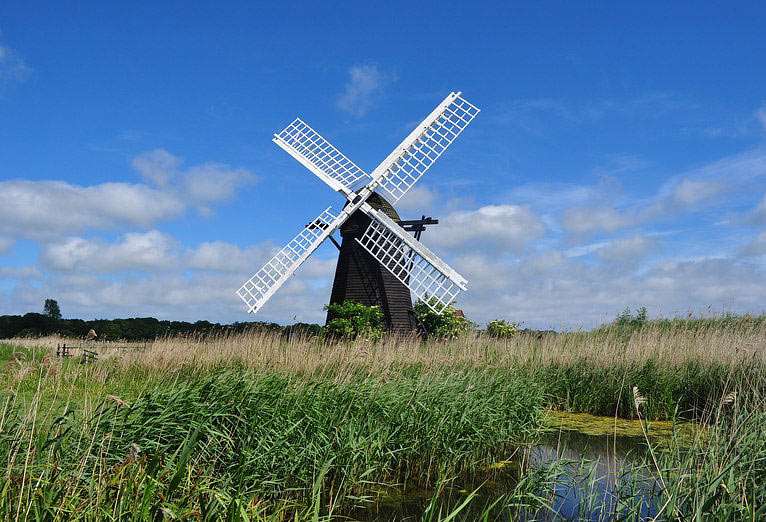
The East Anglian mills illustrated below show how water and wind power have been harnessed over time, from the earliest timber windmills and watermills to 21st-century wind turbines. Windmills continued in use for longer in this rural part of England than in more industrialised areas.

Saxtead Green Post Mill


Cogglesford Mill


Berney Arms Windmill


Herringfleet Smock Mill

Sibsey Trader Windmill


Lincs Wind Farm

How does the mill work?
For a windmill’s sails to turn they must face the wind. If the wind changes, it turns a smaller set of sails – the fantail – set at right angles to the main sails. The fantail causes the whole cap to rotate on a circular iron curb until the main sails face the wind again.
The sails then turn an almost-vertical wheel inside the cap called the brake wheel, which turns the horizontal wallower – the mill’s main power wheel. This turns the main drive shaft, a tall, vertical shaft that runs down four storeys of the mill.
The drive shaft turns the spur wheel, three floors below, which turns three smaller wheels and drive shafts that power the actual millstones. The mill has three pairs of millstones (it used to have four) and, in each pair, the upper or runner stone turns while the lower or bed stone is static.
The speed of rotation is increased by ‘gearing up’ the various wheels: the sails might turn at about 10 revolutions per minute, but the upper millstones can rotate at about 100.
Sacks of grain were delivered to the mill and loaded into the ground floor. The miller used a sack-hoist to pull each sack up through trapdoors to the sack floor, four floors up. He then poured the grain into a small bin which fed the larger bin on the third floor, ready for milling.
Milling took place on the second or millstone floor. Grain came down chutes from the floor above (the bin floor) into hoppers. These fed vibrating ‘shoes’ that shook and poured grain into the central hole of the millstones. The upper stone turned, forcing the grain into the narrow gap between the two stones and grinding it into meal, which could be fine flour or coarse oats. The meal flowed over the outer edge of the lower stone and down the meal chute into a sack on the meal floor below.
The miller controlled most of the operations from the meal floor. He could open a small shutter in the meal chutes to check the consistency of the flour. If necessary, he could pull a rope to increase the flow from the grain bins, or fine-tune the separation of the millstones using the iron tentering screw (which resembles a car jack) above his head. He closed the gap between the stones to make fine flour or increased it to make coarse meal.
The miller could also climb out onto the second-floor balcony, where he could pull a continuous chain to adjust the shutters in the sails. Opening the shutters if the wind was strong prevented the sails from turning too fast.
Changes over time
William Clapham, the first miller at Sibsey Trader Mill, worked here until his nephew Clapham Mawer took over in 1882. In 1919 or soon after, Thomas (Tommy) Ward took on the mill, working here until his death in 1953 at the age of 76.
Tommy, his wife, Elizabeth, and their daughter, Addita, lived in the house next to the mill. On the other side of the mill was Tommy’s workshop, where he repaired and replaced broken mill parts, and pursued his hobby, repairing steam engines.
Milling was a hard life. Millers often had ‘miller’s cough’, an asthmatic reaction to the flour dust. They worked irregular hours: if the wind was good they worked long days. Tommy Ward even installed an oil engine at the base of the windmill so he could work one pair of millstones on wind-free days. He continued working the mill in his seventies, but admitted to one visitor that he wasn’t quite as fit as he had been:
nowadays when A’ve run up to th’ top of th’ mill A’ve to stop and ask meself a question or two.
By the time Tommy Ward died in 1953, the world had changed. Bakers bought flour from electric-powered urban mills and farmers bought animal feed from wholesalers. Tommy was one of the last traditional millers in Lincolnshire.
The mill today
With the death of Tommy Ward, the last full-time miller, in 1953, the mill quickly deteriorated. The government gave it Grade I listed status in 1955, but three years later the owner applied for permission to remove the cap and the four remaining sails – in other words, to turn it into a ruin. Permission was refused.
Fortunately, conservation works by the Ministry of Public Buildings and Works (a predecessor of English Heritage) began in 1970, and the mill was formally taken into state guardianship in 1975. The millwrights Thompsons of Alford restored it to full working order in 1981 and a new miller, Ian Ansell, brought the building back to life as a working heritage mill.
In 2018 the mill was severely damaged in a storm and all six sails had to be removed. Another programme of restoration began, this time carried out by Suffolk millwright Tim Whiting. He rebuilt the mill’s timber cap and sails in his workshop and restored the curb – the iron track at the top of the tower on which the cap turns. The cap was lifted back into place in July 2022 and the restoration work was completed in 2024.
Further reading
TW Beastall, The Agricultural Revolution in Lincolnshire (Lincoln, 1978) [describes the draining of the fens and its effects]
P Dolman, Lincolnshire Windmills: A Contemporary Survey (Lincoln, 1986)
Historic England listed building description
Science Museum, London, HES Simmons archive relating to the wind and water mills of Great Britain [Lincolnshire section, pp 1121–5]
R Wailes, The English Windmill (London, 1954)
Find out more
-

Visit Sibsey Trader Windmill
Discover this imposing brick-built Victorian mill, one of the last windmills to be built in Lincolnshire, and recently restored to bring it back into full working order.
-

Visit Saxtead Green Post Mill
Explore this striking four-sailed post mill, one of just a handful of fully operational mills remaining in Suffolk.
-
MORE HISTORIES
Delve into our history pages to discover more about our sites, how they have changed over time, and who made them what they are today.