McCALL, ANNIE (1859–1949)
Plaque erected in 2026 by English Heritage at Marion Court, 68 McCall Close, Stockwell, SW4 6PU, London Borough of Lambeth
All images © English Heritage
Category
Medicine, Philanthropy and Reform
Inscription
The former CLAPHAM MATERNITY HOSPITAL where Dr ANNIE McCALL 1859–1949 led improvements in maternity care and midwife training
Material
Ceramic
Dr Annie McCall founded the Clapham Maternity Hospital and set new standards for maternity care. She is recognised by a plaque at her former hospital, now Marion Court, 68 McCall Close, Stockwell.
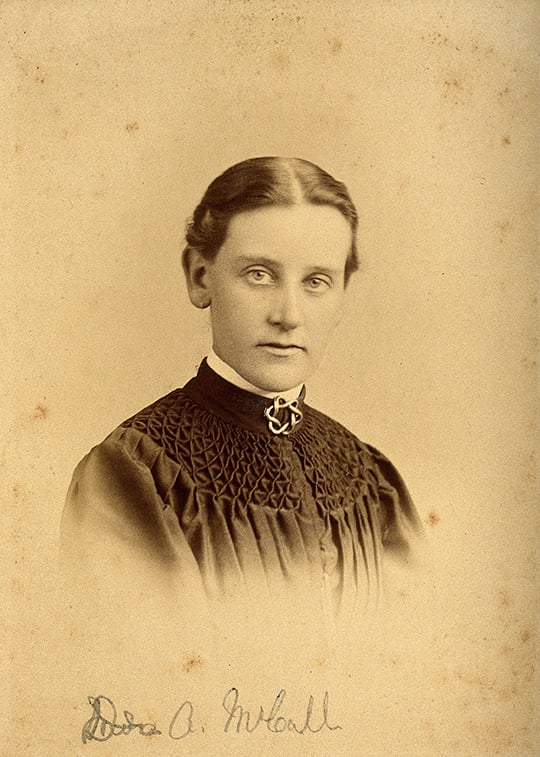
Annie McCall was born on 23 September 1859 in the Moss Side area of Manchester, and was the third of five children. Her father died just four years later, and the family moved to Brighton for her brother’s health, before going to Germany where Annie attended a private school. She was determined to become a doctor and had her mother’s full support, although there were many barriers to women entering this profession at the time.
She initially failed the required entrance examination to attend the London School of Medicine for Women (established in 1874 by a group including Elizabeth Garrett Anderson and TH Huxley) but retook and passed it in 1880, winning an annual scholarship. She was against animal experimentation and refused to write her dissertation about vivisection. After four years of study, she took her medical examinations in Dublin because of the opportunity to obtain a certificate in midwifery, the specialism that became her life’s work.
Dr McCall (as she became after qualifying at Bern University in 1885) went to Vienna briefly to learn about innovative practices in obstetrics and midwifery. She then returned to London ready to begin work in October as resident doctor at a new outpatient clinic for women ex-prisoners in Lambeth. In 1886 McCall opened an antenatal clinic to help pregnant women with information on work, rest, exercise and food. It may have been the first of its kind in the country. The clinic developed post-natal support too. In 1887 McCall left the Lambeth clinic and set up her own outpatients’ department for poor women and children, initially in her own house, which ran until the South London Hospital finally took over the work in 1931.
Improving maternity care
When McCall began working, poor London women experienced high numbers of stillbirths and maternal deaths, and most midwives had very little training. Supported by her companion, hospital administrator Marion Ritchie, McCall established the Clapham Maternity Hospital in 1889 to provide the best possible maternity care. Women were treated by doctors of their own sex and could apply for care there without being referred. McCall was radical for her time in offering care to unmarried women too.
The hospital also provided antenatal care to make pregnancy and childbirth safer and easier. Patients generally stayed for two weeks and women could stay in the ‘waiting home’ during the late stages of pregnancy to receive pre-delivery care. In the 1890s the maternal mortality rate at the hospital was less than half that of the rest of the country.
The highest standards
The hospital had a School of Midwifery to train midwives, nurses and doctors – it was the first to be run for women, by women. The school also accepted students from overseas who wanted to return and work in their own countries. Matron Constance Watney noted that these students were exceptionally good at their work and McCall believed ‘it is character, not colour, that counts’.
Since there were no national regulations for midwife qualifications at the time, the Clapham Maternity Hospital ran its own examinations. With the Midwives Act of 1902, a Central Midwives Board was created, and all new midwives had to pass the Board exam – McCall’s students then took two tests, continuing to take the school’s because its standards were higher than those of the Board. Suffragist Millicent Garrett Fawcett observed that McCall’s very high standards ‘helped build up the public esteem in which women doctors are now held’.
Clapham Maternity Hospital expands
After about three years, McCall and Ritchie moved the hospital to larger premises on Jeffreys Road. Student nurses lived at the hospital and obstetric students lived with McCall at her house. The hospital expanded several times into neighbouring houses. A large bespoke new wing of red brick with three labour rooms and 50 beds and cradles spread across 12 wards officially opened on 23 July 1915; it was designed by Hart & Waterhouse. In 1938 a further extension was commissioned from groundbreaking female architect Gertrude Leverkus.
During the Second World War, bomb damage to the hospital in 1940 was so severe that it had to close temporarily. It was taken over by the Mildmay Mission Hospital in 1941 and became part of the new National Health Service in 1948. McCall continued to organise outpatient work, with her students seeing patients for a mile around, and from locations in Battersea and Stockwell.
The hospital eventually closed in the 1970s and was later redeveloped into homes. The development is now known as Marion Court (after Ritchie) and its entrance is on McCall Close.
Care in other communities
In addition to her devotion to providing maternity care, McCall also ran a tuberculosis sanatorium in Rudgwick, West Sussex, from 1900 to 1939, possibly motivated by her father having died of the condition. There was an additional sanatorium in Norfolk but even the low fees there were too much for some patients, so McCall also set up a dedicated tuberculosis outpatient clinic, first at Battersea and then attached to the Clapham Maternity Hospital.
McCall was also involved in creating the Women’s Scientific Co-operative Farm for Severely Disabled Soldiers, also known as Vanguard Farm, an innovative rehabilitation centre for military personnel near Maidstone in Kent where local women trained the disabled men in farming skills. In 1941 this was taken over by the British Legion.
McCall retired from the Clapham Maternity Hospital in 1941 and died on 9 September 1949 at home in Rudgwick. Her will left most of her estate to the London School of Medicine for Women to establish an Annie McCall scholarship in midwifery.
Further reading
- Beryl M Barrow, ‘McCall, Annie (1859–1949)’, Oxford Dictionary of National Biography (2004) (access with a UK public library card)
Nearby Blue Plaques
See these places on an interactive Google map.