PAYNE-GAPOSCHKIN, Cecilia (1900–1979)
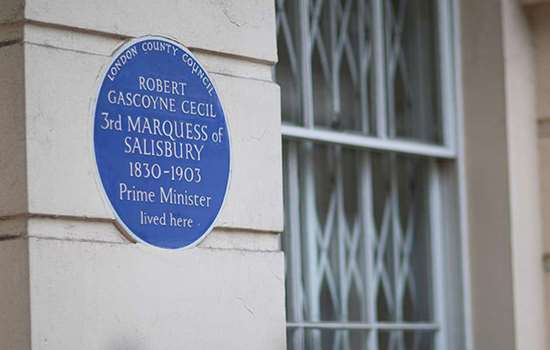
Plaque erected in 2026 by English Heritage at 70 Lansdowne Road, London, W11 2LR, Royal Borough of Kensington and Chelsea
All images © English Heritage
Profession
Astronomer
Category
Science
Inscription
CECILIA PAYNE- GAPOSCHKIN 1900–1979 Astronomer lived here in her youth
Material
Ceramic
Cecilia Payne-Gaposchkin was known for her remarkable contributions to the field of astronomy, including having deduced the chemical composition of stars. She is commemorated by a blue plaque at 70 Lansdowne Road, Notting Hill, where she lived in her youth.
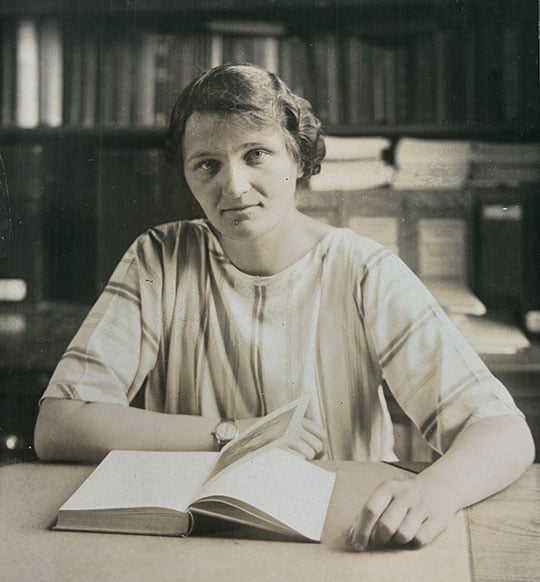
Cecilia Payne was born on 10 May 1900 in Wendover, Buckinghamshire. She was the eldest of the three children of Emma, an artist, and Edward, a historian, barrister and expert on stringed musical instruments who died when Payne was only four.
When she was about 12, Payne’s family moved to 70 Lansdowne Road, a 19th-century terraced house with opulent detailing in a quiet area of Notting Hill. She was determined to be a scientist and was later accepted at St Paul’s School for Girls, which had excellent science facilities and teaching staff who developed her knowledge of physics and chemistry. Another teacher, the composer Gustav Holst, encouraged her love of music.
Discovering astronomy
Payne’s family had money to send her brother to study at the University of Oxford, but not to send her to Cambridge. But by her own ability and initiative, she won the Mary Ewart Scholarship, the only option that could fund her studies.
At Newnham College, a lecture on the theory of relativity by Professor Arthur Eddington convinced Payne to specialise in physics. She attended astronomy lectures and used observatory facilities to pursue her passion. Payne joined the computing section of the British Astronomical Association, worked with Eddington measuring the motions of stars and had her first paper accepted by the Royal Astronomical Society, to which she was elected in 1923.
But it was then extremely difficult for a woman in England to make a career in astronomy; Annie Maunder, for example, undertook lowly paid work at the Greenwich observatory and then gave up professional work when she married.
Harvard and Stellar Atmospheres
The United States then offered somewhat better opportunities, and by winning fellowships and grants, Payne raised enough money to go to Harvard in autumn 1923, where the new director of the observatory, Harlow Shapley, had promised her work. The nature of her funding meant that she could choose her subject area, and she pored over thousands of images of stars on photographic plates, exploring the unexamined data to test a new theory about how the spectrum of light emitted by a star reflects its atoms, temperature and pressure.
In 1925 Payne received the first doctorate in astronomy awarded to an observatory staff member, from Radcliffe College, a women’s college linked to Harvard. The famed astronomer Henry Norris Russell said that her thesis, published as Stellar Atmospheres, was the best he had read (except possibly for Shapley’s), and in 1927, she became the youngest astronomer ever to have a star of distinction next to her name in American Men of Science.
Payne’s research led her to believe that stellar atmospheres were primarily hydrogen and helium, and radically different from Earth. This went against accepted theory, and Russell caused her to doubt her findings. Then, soon afterwards, via a different approach, he and others began to find evidence for the superabundance of hydrogen. When he published his own discoveries, Russell barely mentioned Payne’s work and made no reference at all to his having steered her away from the correct conclusions.
Frustrations and bright stars
After her doctorate, Payne was employed at the observatory. She was put onto a project on the position of stars and given time-consuming work editing the observatory’s publications. As a woman, she was not allowed to have academic jobs at many colleges. Though she was an inspiring lecturer, her courses were not listed in the Harvard catalogue, and she was paid as just a technical assistant. She later observed in her autobiography that ‘I had once pictured myself as a rebel against the feminine role, but in this I was wrong. My rebellion was against being thought, and treated, as inferior’.
When two of her close friends died unexpectedly, Payne sought more from life. She visited observatories in Europe and went to the 1933 conference of the German Astronomical Society, where she met the Russian-born Sergei Gaposchkin, who was under the threat of Nazi persecution. Payne got him a job in the US and they married in 1934. They shared chores and had three children, who were sometimes taken to the observatory when there was no available childcare (two of them later became astronomers). From this time, Cecilia published as Payne-Gaposchkin.
Shapley set the couple to work on variables – stars whose brightness seems to change over time. Payne-Gaposchkin was inspired to use data from the Harvard photographic plates. The pair and their assistants investigated the chemistry and physics of these stars, gaining insights into how stars evolved and galaxies formed. In 1938 they published their findings in Variable Stars. That year, Payne-Gaposchkin was finally given the job title of ‘astronomer’.
Later life
Payne-Gaposchkin was nominated to the National Academy of Sciences in 1939. She became a full professor in 1956, the first woman to hold this role at Harvard. In the 1960s the Payne-Gaposchkin team worked on a similar project on stars in the Magellanic clouds (galaxies that orbit the Milky Way), making two million brightness estimates.
Payne-Gaposchkin retired from active teaching in 1966. Latterly she was attached to the Smithsonian Astrophysical Observatory, but kept her connection to the Harvard Observatory. In 1976 she received the Henry Norris Russell Lectureship, a prize of the American Astronomical Society, recognising a lifetime of eminence in astronomical research.
Payne-Gaposchkin continued to publish books and articles right up until her death in 1979. She left her body to scientific research.
Plaque to Basics
Cecilia Payne-Gaposchkin was nominated for a blue plaque by Xenia, Eleanor and Sophie, who were on a placement with English Heritage’s national youth engagement programme, Shout Out Loud, in 2022. They created ‘Plaque to Basics’, a guide designed to explain the blue plaque nomination process and encourage nominations.
At the unveiling of the plaque, Sophie said,
It was a real pleasure to attend the unveiling of Cecilia Payne Gaposchkin’s blue plaque, and incredibly rewarding to see a nomination we worked on four years ago come to fruition... If anyone knows of a historical figure that they believe deserves recognition in the form of a blue plaque I would definitely recommend going through this process – it is always worth the try!
Further reading
- T. Brück, ‘Gaposchkin, Cecilia Helena Payne-(1900–1979)’, Oxford Dictionary of National Biography (2004) (access with a UK public library card)
Nearby Blue Plaques
See these places on an interactive Google map.