TUCKWELL, Gertrude (1861–1951)
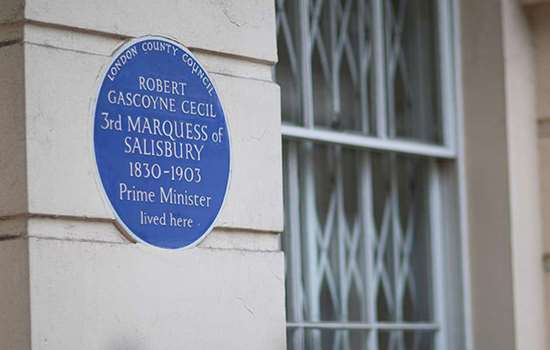
Plaque erected in 2026 by English Heritage at 52 Westminster Mansions, Little Smith Street, SW1W 3BP, City of Westminster
All images © English Heritage
Category
Philanthropy and Reform, Politics and Administration
Inscription
GERTRUDE TUCKWELL 1861–1951 Campaigner for working women, trade unionist and magistrate lived in flat 52
Material
Ceramic
Gertrude Tuckwell was a magistrate and trade unionist known for supporting working women. She is commemorated by a blue plaque at 52 Westminster Mansions, Little Smith Street, where she lived when she led campaigns to improve labour conditions and where she founded the National Federation of Women Workers.
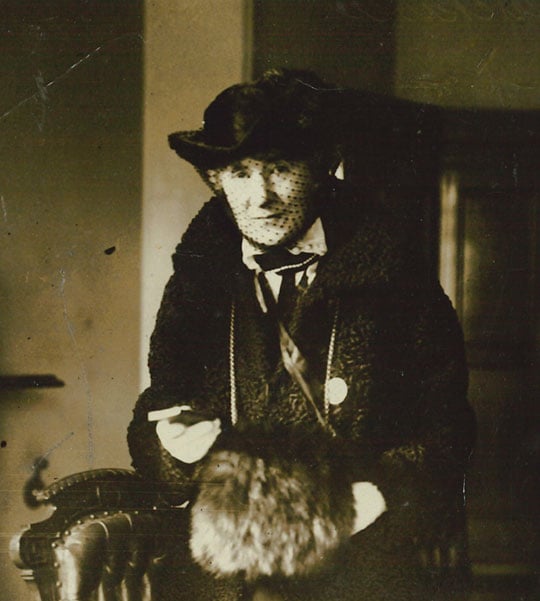
Gertrude Tuckwell was born in Oxford on 25 April 1861. She was educated at home and her parents exposed her to radical Christian values from an early age. Her maternal aunt, Emilia Strong, was a particularly significant influence on Tuckwell, encouraging her interests in cultural and intellectual pursuits, and in trade unionism.
Emilia’s friends encouraged Tuckwell to become a teacher and she trained in Liverpool, where she first witnessed real poverty. After further studies in Chichester, she moved to London in 1884, and taught at an elementary Board School in Chelsea. Tuckwell saw the area’s pockets of extreme poverty reflected in her pupils – their need to work part-time around their schooling led to her opposition to child labour, expressed in her book The State and its Children (1894).
Trade Unions and women in industry
Tuckwell’s Aunt Emilia married the radical politician Sir Charles Dilke in 1885 and Tuckwell found the time she spent with them ‘a lesson in the art of living’. Around this time, Tuckwell became actively involved in trade union and political work. She played important roles in the Women’s Trade Union League (WTUL) and was editor of its journal, the Women’s Trade Union Review.
Beyond her work in social justice and public health broadly, Tuckwell was especially involved in campaigns to improve the conditions of women in industry. She campaigned against the ‘death traps’ where women pottery workers were poisoned by lead glazes, and conditions in match factories where workers developed ‘phossy jaw’, or phosphorus necrosis, from exposure to disease-causing phosphorus fumes. Tuckwell helped establish the Industrial Law Committee with her friend and fellow campaigner May Tennant to enforce laws and fight for reform.
Westminster Mansions
From 1906, Tuckwell lived in flat 52 on the corner of the small northern block of Westminster Mansions in Little Smith Street – a recently built red brick mansion block close to the parliamentary corridors of power. It was while living here that Tuckwell, along with friend and colleague Mary Macarthur, encouraged the Daily News to show people the grim realities of working conditions for low-paid women workers through an exhibition at Queen’s Hall on Langham Place in London. This made a considerable impact, and the National Anti-Sweating League, which Tuckwell helped to found in 1906, continued the campaign against appalling ‘sweatshop’ working conditions.
Though Tuckwell and the Dilkes were unsuccessful in the campaign for a national minimum wage, when the Trade Boards Act passed in 1909, it put Tuckwell’s work into effect by setting minimum wages for some ‘sweated’ trades where women worked for very low wages.
When Emilia Dilke died, Tuckwell became President of the WTUL. She was the first president (1906–18) of the National Federation of Women Workers, which she founded with Macarthur, and was the secretary of the Christian Social Union research committee (1898–1911).
From 1911, when Dilke died, she was his literary executor and became his biographer. She then cared for both of her parents up to their deaths.
Later life
Tuckwell was described in The Woman Worker in 1908 as ‘the power that moves a myriad organisations’, and even after she retired from trade union work in 1918, she continued to advocate for disadvantaged people.
After the Sex Disqualification (Removal) Act 1919 became law, she was appointed one of the first women justices of the peace and was the first woman to be sworn in as a London magistrate. She and Beatrice Webb advised the Lord Chancellor on appointing other women justices. Tuckwell founded the Magistrates’ Association in 1920 and was on its council for nearly 20 years. She also chaired the National Association of Probation Officers from 1933 to 1941.
Tuckwell’s continued concern for working people’s health and wellbeing led her to advise the Ministry of Health, and she served on the royal commission on national health insurance (1924–6). Tuckwell and May Tennant were worried about high maternal death rates and formed the Maternal Mortality Committee. Between 1922 and 1929 she was president of the Women Sanitary Inspectors and Health Visitors’ Association. She was also president of the Women Public Health Officers’ Association and a member of the Women’s Health Inquiry Committee (1939).
In 1939, aged 78, Tuckwell decided to retire and move to Surrey with her companion, Jennet Lush. She died there in 1951.
Further reading
- Angela V John, ‘Tuckwell, Gertrude Mary (1861–1951)’, Oxford Dictionary of National Biography (2006) (access with a UK public library card)
Nearby Blue Plaques
See these places on an interactive Google map.