CHUNCHIE, Kamal (1886–1953)
Plaque erected in 2026 by English Heritage at Queen Victoria Seamen’s Rest, 121–131 East India Dock Road, E14 6DF, London Borough of Tower Hamlets
All images © English Heritage
Profession
Pastor and anti-racist community activist
Category
Philanthropy and Reform, Religion
Inscription
KAMAL CHUNCHIE 1886–1953 Pastor and anti-racist community activist worked here
Material
Ceramic
Kamal Chunchie was known for his work as a pastor supporting marginalised and disadvantaged people of the East End. He is commemorated by a blue plaque at Queen Victoria Seamen’s Rest, where he began decades of work with the black, Asian and mixed-heritage communities.
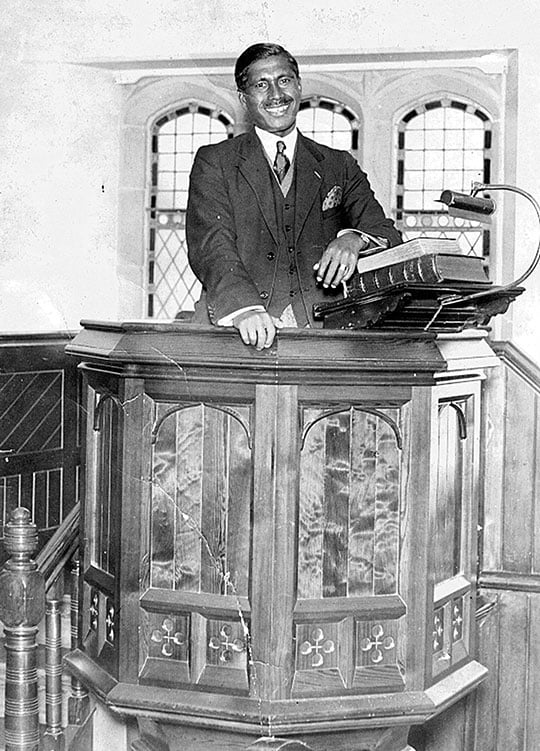
Kamal Athon Chunchie was born in Kandy, Ceylon (now Sri Lanka), on 4 June 1886. His family were of Malay origin, and his father was a leading figure in the Muslim community. Chunchie attended Kingswood College, Kandy, which was modelled on an English public school and managed by the Wesleyan Mission. After school, he joined the police force, rising to sub-inspector.
Chunchie made his own way to England in 1916, joining the British Army in March that year. He served as a private in the Middlesex Regiment in Salonika (now Thessaloniki), in northern Greece, until 1918 and transferred to the Royal Army Service Corps in the UK until his discharge in August 1919. He was entitled to return to Ceylon, but chose to remain in London. By this time, he had converted from Islam to Christianity and apparently felt this would lead to a difficult family situation. He became a speaker, preacher and pastor, but was never ordained.
Queen Victoria Seaman’s Mission
In July 1920 Chunchie and Mabel Tappen married at the Wesleyan Methodist Chapel in Leyton. Muriel Chunchie, their only child, was born soon after.
From 1922 Chunchie undertook much of his missionary and outreach work from the Queen Victoria Seamen’s Rest in Poplar, a branch of the Wesleyan Methodist Missionary Society (WMMS), which was based in an attractive red-brick, stone and stucco Queen Anne Revival style building opened in 1902. The plaque marks the building’s original frontage onto Jeremiah Street, which is the part of the building where he would have been based.
Chunchie had special responsibility for missionary work among black and Asian sailors of the dockland area. He used his fluency in Tamil, Sinhalese, Malay and English to share the gospel and to offer practical help to those in need. He also supported students from India and other parts of the British Empire, as well as the small resident population of black and Asian people in the docklands.
The shipping industry had long contracted black, Asian and mixed-heritage sailors and dock workers, but the hostility they often faced was exacerbated by the economic depression after the First World War. Colour bars blocked access to jobs, leisure and housing. Chunchie himself was refused service in a café and became – in the words of his biographer – ‘an outspoken champion on behalf of the “coloured” peoples of the East End’ (coloured was the term used at the time).
In 1922 Chunchie set up the first Coloured Men’s Wesleyan Methodist Church and a Sunday school in a rented hall in Canning Town. As well as religious sustenance, Chunchie organised food, clothing, medicine and seaside excursions for the poorest of the community. He advocated a ‘recreative institute’ for those effectively excluded by racism from existing spaces. When his relationship with the Seamen’s Mission became strained, he transferred to the East London Mission and on 1 January 1925 the WMMS approved plans for a permanent religious and social centre.
The Coloured Men’s Institute
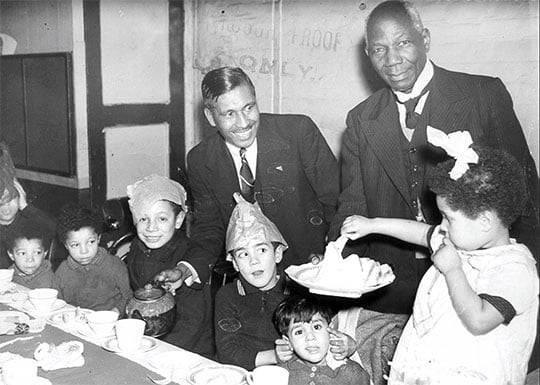
The Coloured Men’s Institute (CMI) opened in Canning Town in February 1926 with Chunchie as pastor and warden. It offered a church, social centre, Sunday school, prayer room, writing room and billiard room; the Chunchie family lived on the top floor. Funding did not cover all the running costs and Chunchie preached in churches and halls all over the country, often to packed congregations, to raise money.
Some criticised Chunchie’s approach – the East End branch of the Universal Negro Improvement Association accused him of patronising black people – and the WMMS withdrew its support towards the end of the decade. The CMI building was demolished for road widening, and the WMMS did not look for a replacement. After recuperating from a breakdown, Chunchie was allowed to use the Barking Road Methodist Church, Canning Town, for a weekly evening centre but mainly spent his time travelling and preaching to raise support for mission work.
Commitment to the East End
In August 1932, Chunchie and the WMMS parted ways. Rozina Visram, author of a history of Chunchie and the CMI, suggests that his outspoken criticism of the racism of white people in England might have rankled with Mission House leadership, but concludes that their main disagreement was over the priorities of the CMI. Chunchie insisted on the need to provide material help – it was ‘no use talking about religion to a man with cold feet and an empty stomach’ – but the Methodist leadership preferred to prioritise spiritual approaches. Despite this official parting, support for Chunchie and his work from within and without the Methodist community continued for years.
Chunchie was determined to continue his work in the East End and between 1933 and his death in 1953, he worked independently to create a new Coloured Men’s Institute. Vice-presidents included Dr Harold Moody, President of the League of Coloured Peoples. Based at the Chunchies’ home in Lewisham, the new CMI’s work included providing bed and breakfast to stranded seamen, Christmas dinners and Christmas gifts to hundreds of families, day trips to the countryside and by the seaside, and huge numbers of fuel vouchers and parcels of clothing and essentials.
As the CMI’s charitable work increased during the 1930s and the years of the depression, so did expenses, and the CMI experienced financial difficulties. Chunchie used his own money and travelled the country to raise support. During the Second World War, he also volunteered as a firefighter in Lewisham. The destruction of the war diminished black, Asian and mixed-heritage communities in the docklands, which took many years to re-establish. Despite Chunchie’s efforts, by 1950 the CMI had a deficit of £665. Chunchie’s health broke down under the strain of work and financial pressure, and he died in June 1953, aged 67.
Further reading
- Rozina Vizram, ‘Chunchie, Kamal Athon (1886–1953)’, Oxford Dictionary of National Biography (2004) (access with a UK public library card)
- ‘Kamal Chunchie and the Coloured Men's Institute’, Eastside Community Heritage Archive
- ‘Chunchie’, Eastside Community Heritage YouTube
Nearby Blue Plaques
See these places on an interactive Google map.