ZWEIG, Stefan (1881–1942)
Plaque erected in 2026 by English Heritage at 49 Hallam Street, Marylebone, W1W 6JW, City of Westminster
All images © English Heritage
Profession
Austrian writer
Category
Literature, Theatre and Film
Inscription
STEFAN ZWEIG (1881–1942) Austrian Writer lived here in flat 71 1936–1939
Material
Ceramic
Stefan Zweig was known for his prolific literary output and his internationalist outlook. He is commemorated by a blue plaque at 49 Hallam Street, Marylebone. He was the first resident of flat 71 and lived there from March 1936 to September 1939.
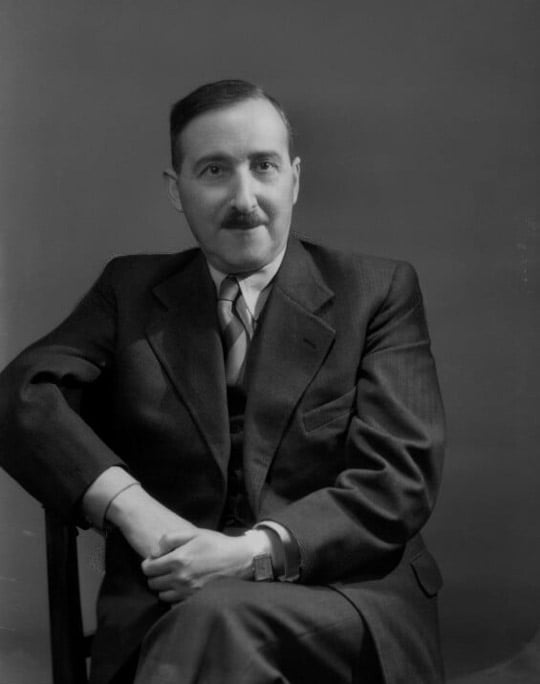
Stefan Zweig was born on 28 November 1881 in Vienna, which was then one of the two capitals of the Austro-Hungarian Empire. He and his older brother Alfred lived in a comfortable home with their Jewish parents who raised them with the help of a governess and their grandmother. Summer holidays were spent in spa towns and resorts.
Zweig described his schooling as ‘compulsion, ennui, dreariness, a place where we had to assimilate the “science of not-worth-knowing” in exactly measured portions’. He gained a hatred of authoritarianism and, outside school, eagerly read the latest literature and contemporary poetry.
Early writing
From 1900 Zweig studied philosophy and literature at the University of Vienna. Early success with a collection of poems, Silver Strings (1901), and his first novella, The Walking Tour (1902), helped to convince his parents that his future lay in literature rather than the family textile business run by his brother, which provided Zweig with a steady income.
In Vienna, Zweig translated Paul Verlaine’s poetry into German and mixed with artists including Rudolf Steiner. He recalled ‘I sat at the same table with alcoholics and homosexuals and morphine addicts … The kind of characters that I had found hard to believe in the novels of the realists were all crowded in together in the little pubs and cafés.’
He also travelled widely. In summer 1906 he visited London and studied manuscripts in the British Museum. He fell in love with the work of William Blake but struggled with the English language and failed to find a group of friends. After travelling from New York with Gustav Mahler in 1911, one month before the composer’s death, Zweig wrote about him. He considered Mahler’s death a turning point in history and called this approach to the past a ‘Weltminute’ or ‘world minute’. He published a collection of these as Decisive Moments in History (1927).
Interwar works and move to London
During the First World War, Zweig was conscripted and wrote reports of soldiers’ valour for the Austrian Ministry of War. Initially, he publicly supported Germany’s position but privately recorded his fears. Later, he wrote an anti-war play, Jeremias. It premiered in 1918, and its positive reception led him to speak out against the war.
After the conflict he focused on a new life in a villa in Salzburg which he shared with his new wife, Friderike, and her two daughters. He was particularly creative during this period and wrote many popular works including Fear (1920), Letter from an Unknown Woman (1922) and Amok (1922). He also wrote biographies of Friedrich Nietzsche (1925), Marie Antoinette (1932) and contemporary writers.
The rise of the Nazi party in Germany brought increased hostility to Jewish citizens in Austria and Zweig’s home was raided by the police in 1934. He left Friderike to pack up the house and he settled in London, where he had spent some months in 1933. When Germany annexed Austria in March 1938, Zweig’s books were burned in Salzburg.
In London Zweig initially stayed at Brown’s Hotel in Mayfair and then in a small furnished flat in Portland Place, but in October 1935 he saw the new development at 49 Hallam Street, Marylebone. The Portland stone-fronted mansion block featured 86 flats and a basement restaurant that operated as a club so it could sell alcohol. From March 1936 Zweig and his secretary and new partner, Lotte Altmann, found a home as the first occupants in flat 71.
Here, with Lotte’s assistance, Zweig wrote his longest novel, Beware of Pity (1938). This work was influenced by psychoanalytical theories developed by his friend and fellow refugee, Sigmund Freud, whose eulogy he read at Golders Green cemetery in 1939. A major factor in choosing where to live was the proximity of the Reading Room at the British Museum. In a letter to Friderike, he reassured her that ‘I have the best library available and can work most profitably there … Always be completely clear-cut about the really important things.’
He felt settled in London and, despite the worsening political situation, thought that ‘the general atmosphere is pleasant and peaceful and you don’t feel there is the least bit of nervousness’. His name and address, however, were included in the so-called Nazi ‘Black Book’ of people to be detained if Germany invaded Britain.
Wartime moves and death
Zweig and Friderike were divorced in 1938, and in September 1939 Zweig and Lotte married and moved to Bath. They acquired British citizenship in 1940 but left for New York, where his brother Alfred had emigrated in 1938. Zweig began writing his autobiography, and the couple moved to Brazil in August 1941, where he worked on his novella The Royal Game (1942).
Although geographically distant from the war, Zweig was deeply affected by the worsening political situation in Europe and became depressed. On 23 February 1942, the day after Zweig and Lotte completed work on his autobiography, The World of Yesterday (1943), they ended their lives at their home in Petrópolis. Their deaths echoed part of the plot of Zweig’s unfinished novel, The Post Office Girl.
The continuing appeal of Zweig’s work is well illustrated by the popularity of Wes Anderson’s film The Grand Budapest Hotel (2014), which was inspired by both his life and his writing. Its success underlines the fundamentally internationalist outlook of Zweig, who wrote in his autobiography: ‘I was sure in my heart from the first of my identity as a citizen of the world.’
Further reading
- Stefan Zweig, The World of Yesterday (Die Welt von Gestern, translated by Benjamin W Huebsch and Helmut Ripperger, 1943)
- Friderike Zweig, Married to Stefan Zweig (New York, 1946)
- Stefan and Friderike Zweig: Their Correspondence, 1912–1942 (translated by Henry G Alsberg and Erna MacArthur, 1954)
- The British Library Stefan Zweig Collection: Catalogue of the Literary and Historical Manuscripts (edited by Susan Reed and Sandra Tuppen, 2017)
Nearby Blue Plaques
See these places on an interactive Google map.