
The Foundation of Battle Abbey
The Benedictine abbey of Battle was founded by William the Conqueror in about 1071. It was established as a memorial to the dead of the battle and as atonement for the bloodshed of the Conquest. Read more about how the abbey has its origins in the great battle of 1066 and the reasons why William chose the particular site on the battlefield for its foundation.
An Act of Penance
According to the late 12th-century Chronicle of Battle Abbey, William made a speech immediately before the Battle of Hastings in which he pledged to found a monastery. The Conqueror explained:
I make a vow on this very battlefield I shall found a monastery for the salvation of all, and especially for those who fall here, to the honour of God and his saints, where servants of God may be supported: a fitting monastery, with a worthy liberty. Let it be an atonement: a haven for all as free as the one I conquer for myself.
In fact, the impetus for founding the abbey of St Martin at Battle on the very site of the Battle of Hastings probably lies in the penances the bishops of Normandy imposed on the Conqueror and those who fought with him. A document known as the penitential ordinances thought to date to 1067, sets out the requirements for penance according to the amount of violence perpetrated by each individual, whether at the Battle of Hastings or during the period of conquest that followed.
A Broken Oath
The Norman invasion and conquest of England had an explicit religious dimension. Norman authors stress that Harold was a perjurer – according to them, he had broken an oath, sworn on sacred relics in 1064, to support William’s claim to succeed Edward the Confessor, and usurped the English throne. Because of this, William gained church support for his invasion of England.
Even Pope Alexander II gave the enterprise his sanction, enabling William to invade under a papal banner, promising to depose the sacrilegious Harold and reform the English Church.
Souls in Peril
Yet despite this religious support, William and his supporters had imperilled the everlasting safety of their souls – they risked going to Hell for all eternity – because of the violence of the conquest. Even by medieval standards the Battle of Hastings, and the subsequent suppression of English resistance, were exceptionally bloody.
Founding an abbey was a way for William to atone for such terrible sins. Other victors had done so before him: Count Fulk Nerra of Anjou founded Loches Abbey after his victory over the Bretons at the Battle of Conquereuil in 992, and King Cnut established a memorial church on the site of the Battle of Assandun in 1016, where he had defeated Edmund II (Ironside) to take the English throne.
Several of William’s leading supporters also founded monasteries. Fear of eternal damnation was undoubtedly behind the decision of Roger of Montgomery, Earl of Shrewsbury, to establish a Benedictine monastery in the town, and he also founded the Cluniac priory at Wenlock, Shropshire, in about 1080. William de Warenne, who fought at the Battle of Hastings, sought security in the afterlife by founding a priory near his castle at Castle Acre in Norfolk. Eudo, the Conqueror’s steward, founded Colchester Abbey in 1096.
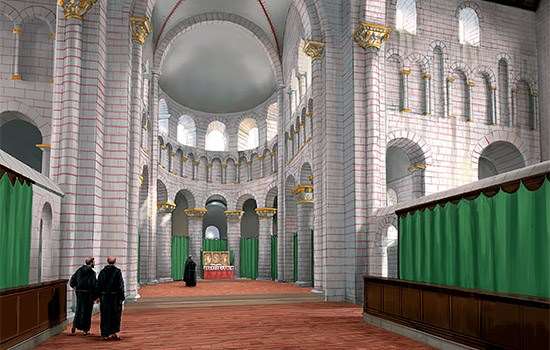
Each day the monks of Battle assembled in their church to sing the Divine Office. At all their religious services, the community would have remembered the Conqueror, the founder of their abbey, and also all those who died at the battle – Norman and Saxon alike – in their prayers. Indeed, the abbey’s Chronicle states that the monastery was to be ‘a place of sanctuary and help for all, paying back for the blood shed there by an unending chain of good work.’
In William’s Memory
As well as being an act of penance, the sources make clear that William also intended his foundation at Battle Abbey to act as a memorial to his great victory. The earliest source, written by a monk of Battle within living memory of the Conquest, describes how William built the abbey ‘to the memory of his victory’.
Memory of King William endured at Battle well into the late Middle Ages. The monastery’s accounts for 1375–6 record that wine was bought for the monks for a feast on the anniversary of William’s death, when a special commemorative mass would also have been sung. Boards painted with the armorials of 364 families that had participated in the Conquest adorned the church, and in 1495–6 the monks bought an image of William in London.
These were not only tangible reminders to the monks of their royal founder and the knights who fought with him – they also acted as visual prompts to pray for the everlasting salvation of their souls.
Dr Michael Carter FSA FRHistS
Explore more
-

1066 and the Norman Conquest
Find out much more about the Battle of Hastings and the events of 1066, and discover where to find some of the most spectacular castles and abbeys the Normans built across England.
-
History of Battle Abbey
Read an in-depth history of the abbey founded by William the Conqueror after the Battle of Hastings, from its foundation to its suppression and after.
-

Visit Battle Abbey
From the drama of 1066 to the peace of a ruined abbey, there’s plenty for the whole family at Battle Abbey in East Sussex, the site of the 1066 Battle of Hastings.