10 places to see amazing colour this autumn
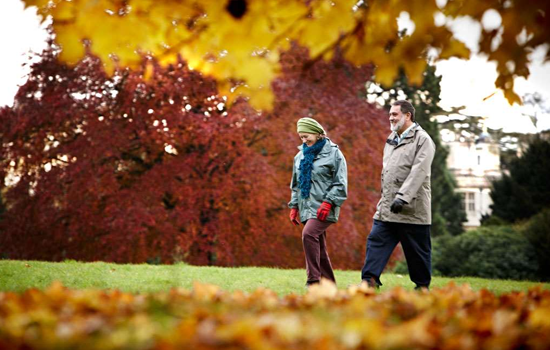
Autumn's a great time to see an array of different colours at historic sites, both in our gardens and indoors.
Check out our top 10 recommendations and see how many you can tick off this autumn!
1. Vibrant flowers at Audley End in Essex
The gardens at Audley End House were among the largest and most opulent in Jacobean England in the early 17th century. The parterre garden, which to this day contains a dazzling array of colourful planting, was created by William Sawry Gilpin in the 1830s.
Autumn colour at Audley is also provided by parkland trees, many of them dating from the 18th century, and colourful pumpkins and squashes grown in the organic walled Kitchen Garden.
Visit Audley End House and Gardens2. Red sandstone at Furness Abbey in Cumbria
Founded over 900 years ago, Furness Abbey was once the largest and wealthiest monastery in north-west England. Today, its beautiful red sandstone ruins, cradled in a wooded valley, are some of the finest in England.
Climb to the observation platform at the ‘night stair’, which monks used to descend from the first-floor dormitory to the church during the night, for a monks’-eye view of the ruins.
Visit Furness Abbey3. Opulent red and gold at Apsley House in London
Home of the first Duke of Wellington, the sumptuous Apsley House stands right in the heart of London at Hyde Park Corner.
The double-height Waterloo Gallery, one of the great palatial interiors of Britain, was designed in an gilded Louis-XIV style, with seven mirrored window shutters and red damask wallpaper.
Today, the dazzling gallery retains its original function as a display room for Wellington’s collection of paintings.
Visit Apsley House4. Orange leaves at Brodsworth Hall in South Yorkshire
Brodsworth Hall's 15 acres of pleasure gardens were laid out at the same time as the hall was being built in the mid-19th century. Like the hall, the gardens are Italianate, and today feature brilliant bedding, formal topiary, a fern-filled dell, and quirky garden buildings.
Autumn brings out the incredible colour of the many trees that can be found in Brodsworth's gardens, which become the perfect place to get lost in oranges, reds, and yellows.
Visit Brodsworth Hall and Gardens5. Black Worcester pears at Kenilworth in Warwickshire
The garden at Kenilworth Castle was specially created by Robert Dudley in 1575 for the visit of Elizabeth I, Dudley's childhood friend. Today's re-creation of the garden features a Renaissance aviary, plant beds full of scent, colour and fruit, and an imposing fountain.
In autumn, you can see a special kind of pear on trees in the four corners of the garden: the Black Worcester, named for the tree's dark colouring. While the pears themselves aren't black, they are a beautiful blend of green, brown, and red - well worth a close-up look.
Visit Kenilworth Castle and Elizabethan Garden6. All the greens at Belsay Hall in Northumberland
The vast 30-acre, Grade-I-listed gardens at Belsay Hall change with the seasons, and the amazing Quarry Garden is no exception.
The Quarry Garden was created where stone was quarried for the hall, and the garden has its own microclimate, meaning all sorts of exotic plants grow here. These provide a spectrum of greens dotted with other colours such as the brilliant white bark of Himalayan birch and the red leaves of the spindle tree.
Visit Belsay Hall, Castle and Gardens7. Changing seasonal colours at Hadrian's Wall
Stretching 73 miles from coast to coast, Hadrian’s Wall was built to guard the wild north-west frontier of the Roman Empire. Today you can discover the remains of the forts and towns that once kept watch over it and walk along remaining sections of the Wall itself.
As you do so, admire the changing seasonal colours of the stunning sky and landscape that you can see from the Wall - perhaps imagine yourself as a Roman legionary looking out over the same view 2,000 years ago.
Visit Hadrian's Wall8. Luscious lichens at Stonehenge in Wiltshire
At first glance, it's easy to miss the fact that the majestic stones that make up Stonehenge are covered in grey-green lichens.
The most noticeable is the hairy-looking sea ivory, a shrubby lichen that's a symbiosis between algae and fungi - you'll be able to spot this one even from the path around the monument.
If you want to see the lichens much closer up, you can sign up for our Stone Circle Experience - but remember not to touch the stones, as this can damage the lichens.
Visit Stonehenge9. Beautiful brown timbers at Gainsborough Old Hall in Lincolnshire
Gainsborough Old Hall, an imposing mansion largely built during the 15th century, has had many different uses over the centuries.
Its highlight, however, remains the magnificent timber-framed medieval Great Hall, with its characteristic striped black-and-white appearance.
You can also climb the Old Hall’s tower for views over the town and the river Trent, then take a break in the tearoom in the 15th-century parlour.
Visit Gainsborough Old Hall10. Multicolour stained glass at Carisbrooke on the Isle of Wight
St Nicholas' Chapel was built in 1904 at Carisbrooke Castle to commemorate the 250th anniversary of the execution of Charles I, who was held prisoner at the castle for 14 months before his execution in 1649.
The multicolour stained-glass window above the altar is stunning at any time but especially when the sunlight shines through in the afternoon. If you're after more autumn colour, be sure to check out the charming Princess Beatrice Garden, based on the original garden retreat of Queen Victoria's daughter.
Visit Carisbrooke Castle