
Katherine and Frances, Countesses of Scandal
Katherine Knyvett was a teenager when she moved into Audley End in Essex in 1583 to join her new husband, Thomas Howard. The ambitious Howards climbed the intensely competitive hierarchy of Elizabeth I’s royal court. They eventually reached the highest rungs of the social ladder during the reign of Elizabeth’s successor, James I.
But a spectacularly scandalous downfall soon followed, culminating in their 25-year-old daughter Frances facing execution for murder. Katherine was widely suspected of masterminding the crime. Discover how these two countesses plunged into one of England’s greatest political scandals.
The Rise and Rise of Katherine Knyvett
Born in 1564, Katherine grew up at Charlton Park, a modest manor house in Wiltshire. She was the oldest of six children, but her younger brother was expected to inherit the property.
To ensure Katherine’s financial security, her parents married her to the aptly named Richard Rich, who was expected to become the 3rd Baron Rich. But when she was just 16, her husband unexpectedly died. Young, beautiful and now wealthy too, Katherine was an attractive prize for ambitious single aristocrats.
Her distant relative, Thomas Howard, was living at Audley End under the cloud of his father’s execution for treason ten years earlier. He convinced Katherine that he could rebuild his reputation and reclaim the family property that Queen Elizabeth had confiscated.

A Marriage of Ambition
Katherine married Thomas in 1583 and they went on to have 12 children, who – unusually – almost all survived to adulthood. Soon after the birth of their first child, Elizabeth I restored Thomas to his inheritance. Their infamous seventh child, Frances, was born on 31 May 1590.
Thomas performed heroically as a naval commander against the Armada in 1588 and in later attacks on Spanish fleets. In April 1597, Elizabeth I made him a Knight of the Garter. Meanwhile, Katherine worked her way closer to the queen, serving as a Lady of the Bedchamber and then, in 1599, as Keeper of the Jewels.
When the queen died and James I became king in 1603, the Howards consolidated their positions quickly. Katherine chose jewels for the new queen, Anne of Denmark, and travelled north to accompany her into London.
Their social manoeuvring worked. Within four months, King James made the couple Earl and Countess of Suffolk. Queen Anne confirmed Katherine’s roles as a Lady of the Drawing Chamber and Keeper of the Jewels. The Howards’ status was strengthened on 5 November 1605, when Katherine’s uncle, Thomas Knyvett, arrested Guy Fawkes, saving the new king from the Catholic Gunpowder Plot.
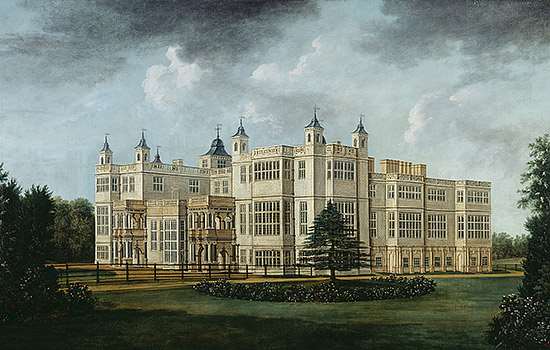
Around this time, the Howards started rebuilding Audley End. They were determined to transform it from a mere makeover of a medieval abbey into England’s most magnificent private house. Not satisfied with one lavish project, they rebuilt Charlton Park too. To fund their lifestyle, Katherine began to secretly pass information to the Spanish in return for the huge sum of £1,000 per year.
Frances’s Husband and Lover
When Frances Howard turned 14, her parents arranged her marriage to 13-year-old Robert Devereux, the 3rd Earl of Essex. It was a political match and the newlyweds scarcely met before Devereux left on a tour of Europe.
When he returned in 1609, Frances was 18 and famous for her beauty. The couple began to live together, occasionally staying at Audley End. But no physical relationship developed. Perhaps this was because Devereux contracted smallpox, which left him physically and psychologically scarred. Or perhaps because Frances had already begun a relationship with Robert Carr, a handsome Scot.
Like Frances, Carr was already in a relationship, with Thomas Overbury, a lawyer. Overbury had also enticed King James to take Carr under his royal wing, probably as a lover, and Carr was becoming the king’s most trusted advisor.
Two years later, King James made Carr a Privy Councillor and named him Viscount Rochester. Carr now had better prospects than Devereux, and Frances went to court to get a divorce. This became a humiliating public spectacle.
Rhymes and Retaliation
Frances was subjected to a gynaecological examination by 12 female experts to verify her claim that she had never slept with Devereux. Even then, it was rumoured that someone else had taken Frances’s place, because the woman who was inspected remained veiled throughout the examination. A mocking rhyme circulated in the royal court:
This Dame was inspected, but Fraud interjected
A Maid of more perfection
Whom the midwives did handle, whilst the knight held the candle -
O there was a clear inspection!
Overbury threatened to leave Carr if he didn’t end the relationship with Frances, and circulated copies of a poem – A Wife – which was a thinly disguised attack on her.
In retaliation, the Howards persuaded King James to appoint Overbury as Ambassador to Russia. As they hoped, Overbury refused to leave England (and Carr), so the furious king imprisoned him in the Tower of London.
Overbury died there five months later, in the early hours of 15 September 1613, in agony. His stomach was covered in yellow blisters, his back was discoloured and his skin smelled.
The Lieutenant of the Tower, Sir Gervase Elwes, said that his young prisoner had died of natural causes. But Elwes happened to owe his job to the Howards, and one of Overbury’s fellow prisoners, the Countess of Shrewsbury, had a different story to tell.
Top of the Social Ladder
Ten days after Overbury’s death, Frances got her divorce and a few weeks later King James made Carr the Earl of Somerset. The wedding of 23-year-old Frances to Carr on 26 December 1613 – which made her the Countess of Somerset – was the social event of the year.
About this time, work on Audley End finished, in time for a three-day visit by James I. The Howards paid huge bills for entertaining the king and his followers at their enormous mansion, which was far larger than the building that survives today.
In mid-July 1614, James I made Thomas Howard his Lord Treasurer. A week later, the king again stayed at Audley End and reportedly joked ‘This house is too great for a king – though it might suit a Lord Treasurer’.
‘A Net to Catch the Little Fishes’
It took nearly two years before the Countess of Shrewsbury divulged her evidence about Overbury’s death. In the summer of 1615, she revealed to one of Carr’s rivals that a well-dressed widow in her mid-thirties named Anne Turner had regularly delivered food to Overbury.
Turner sold yellow starch made from saffron crocuses like those grown near Audley End, which was fashionable for stiffening lace collars and cuffs. As the widow of a physician, she kept in contact with some of her husband’s medical colleagues, including the disreputable Simon Franklin.
Sir Gervase Elwes was then tricked into a confession. He revealed that Turner was a friend of Frances Howard and claimed that throughout Overbury’s captivity, Turner had dosed the puddings she delivered with arsenic, nitric acid and mercury obtained from Franklin. Apparently, she also used cantharidin, a deadly toxin made from ‘blister beetles’. Even the medicines Overbury was given to treat his worsening condition were full of poison.
Elwes also revealed that Overbury’s jailer, Richard Weston, had accepted bribes from Frances. After 18 days of interrogation, Weston admitted his involvement. King James was informed.
Weston begged his captors ‘not to make a net to catch the little fishes, whilst the great ones are allowed to escape’. The authorities seemed to agree: in October 1615, a heavily pregnant Frances, and her husband, were arrested on suspicion of murder.
The four ‘little fishes’ – Anne Turner, Simon Franklin, Sir Gervase Elwes and Richard Weston – were hanged. Turner’s executioner wore a yellow starched collar and cuffs, in an effort to end the fashion.
Frances admitted her guilt, but her husband did not – it is unclear how much he knew of the scheme. On 9 December 1615, Frances, under house arrest, gave birth to a daughter and named her Anne, possibly remembering her executed friend.
Eventually, in May 1616, the ‘great fishes’ – Frances and her husband – were found guilty of murder. They were sentenced to death and sent to the Tower of London to await execution.
‘Fortune’s wheele is quicklie turned aboute’
When Frances was convicted, attention turned to her mother, and Katherine soon plunged into her own scandal.
In 1619, Katherine and Thomas Howard were put on trial for corruption and embezzlement. The English ambassador in Madrid presented evidence of the payments Katherine had received from the Spanish. The judge also accused Katherine of ‘running the Treasury like a shop’ because she accepted so many bribes.
Around this time, 55-year-old Katherine suffered an attack of smallpox. Many people saw the scars on her beautiful face as a punishment from God. They suspected her of manipulating her husband and masterminding her daughter’s crime. The judge fined the Howards £30,000 (over £5 million today) and imprisoned them in the Tower indefinitely.
Things looked grim for the family, but just ten days later, Katherine and Thomas got their powerful allies to negotiate their release. The fine was reduced to £7,000. Even Frances and her husband suffered only three more years imprisonment: they escaped execution.
The disgraced Howards returned to Audley End, where they lived quietly. Katherine outlived both her husband and Frances. She died peacefully in the decaying mansion, at the grand age of 74.
Further Reading
- ‘The poisoning of Sir Thomas Overbury’, Society of Antiquaries of London (accessed 3 March 2026)
- Alastair Bellany, ‘Howard [married names Devereux, Carr], Frances, countess of Somerset (1590–1632)’, Oxford Dictionary of National Biography (2004) (access with a UK public library card)
- Helen Payne, ‘Howard [née Knyvett; other married name Rich], Katherine, countess of Suffolk (b. in or after 1564, d. 1638)’, Oxford Dictionary of National Biography (2004) (access with a UK public library card)
Find out more
-
VISIT AUDLEY END
Explore an English country house upstairs and downstairs, inside and out.
-
HISTORY OF AUDLEY END
Read a full account of Audley End’s long and varied history, from the priory founded on the site in the 12th century to the present day.
-
Collection Highlights
View detailed images of some highlights from the diverse collection at Audley End – from paintings to natural history tableaux.
-
Women in History
Read about the remarkable lives of some of the women who have left their mark on society and shaped our way of life – from Anglo-Saxon times to the 20th century.